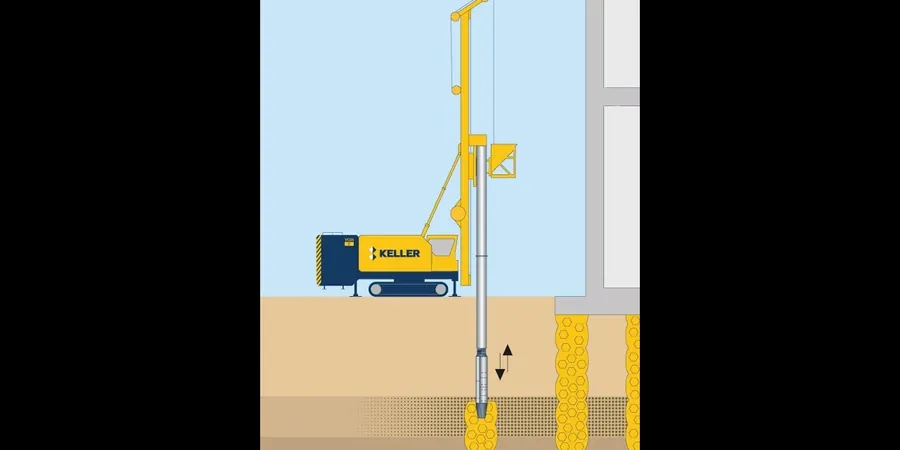
Too many contractors in Garden Grove assume a standard compaction pass is enough for building pads on the old floodplain soils. That assumption often leads to differential settlement within the first year. The alluvial sands and silty layers beneath this part of Orange County are loose, saturated, and prone to liquefaction during a seismic event. A proper vibrocompaction design densifies those granular soils in depth, not just the top foot. Before moving to foundation work, we typically run a permeability test to confirm drainage behavior across the site. That data directly influences probe spacing and energy application during the vibro process. Getting the design wrong means costly rework or structural damage later.
In Garden Grove's saturated alluvium, vibrocompaction probe spacing can make the difference between a stable pad and a settlement claim.
Methodology and scope
Garden Grove sits on a deep alluvial basin where groundwater sits only a few feet below grade. That high water table changes how vibrocompaction behaves in practice. The vibratory probe displaces water upward as it densifies sand, so we design drainage paths and a working platform that can handle that transient saturation. For sites with interbedded silt lenses, we integrate a subgrade soil classification to map the non-granular zones that may need pre-drainage or replacement. Key parameters we adjust for Garden Grove conditions:
Probe spacing based on relative density target (typically 70-85%)
Vibration frequency tuned to the natural frequency of the loose sand layer
Backfill material gradation to avoid clogging during compaction
Water injection rate control to prevent excess pore pressure buildup
Technical reference image — Garden Grove
Local considerations
In Garden Grove we often see vibrocompaction designs that under-estimate the effect of fines content. A sand layer with even 12% silt can drastically reduce the vibration transmission and leave loose pockets between probes. The real risk is not catching those pockets until the foundation load test reveals excessive settlement. We always request a detailed grain-size distribution before finalizing probe spacing. For layers with high fines, we adjust to tighter spacing or switch to a stone column approach. Another common oversight is ignoring the existing buried utility corridors that can transmit vibrations to adjacent structures.
Boreholes with SPT and undisturbed sampling to map loose sand layers, fines content, and groundwater depth. We use ASTM D1586 and D2487 for classification.
02
Vibrocompaction Parameter Design
Calculated probe spacing, vibration frequency, energy input, and backfill specification based on target relative density and site-specific soil conditions.
03
Post-treatment Verification Testing
CPT or SPT soundings at midpoints between probes to confirm density improvement. We issue a report with comparison to pre-treatment values and acceptance criteria.
Applicable standards
ASCE 7-22 (Minimum Design Loads for Buildings, Chapter 20 – Site Classification), IBC 2021 (Section 1806 – Foundation Design, Deep Compaction references), ASTM D4253-16 (Maximum Index Density and Unit Weight of Soils by Vibratory Table)
Frequently asked questions
How deep can vibrocompaction treat soil in Garden Grove?
Typically up to 18 meters, depending on the sand layer thickness and equipment reach. The alluvial deposits here often extend deeper, but the effective treatment zone is governed by the probe length and vibration energy.
What is the difference between vibrocompaction and dynamic compaction?
Vibrocompaction uses a deep vibrating probe inserted into the ground to densify granular soils in depth, while dynamic compaction drops a heavy weight from a crane to compact the upper 6-10 meters. Vibrocompaction works better in saturated sands and can reach deeper layers.
How much does vibrocompaction design cost for a typical Garden Grove project?
The engineering design portion typically ranges between US$1,320 and US$4,600 depending on site complexity, number of borings, and verification testing volume. Larger sites with variable soil profiles fall at the higher end.
Does vibrocompaction reduce liquefaction risk in Garden Grove?
Yes, when properly designed. Densifying loose sand to 70-85% relative density significantly reduces pore pressure buildup during shaking. The design must account for fines content and groundwater level to achieve the required post-treatment SPT blow counts per ASCE 7 site class criteria.