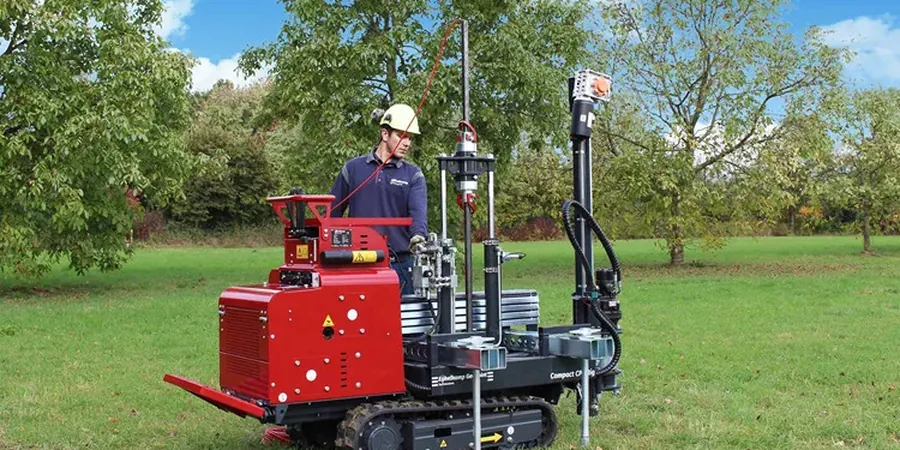
The coastal fog and seasonal rains in Orange County create variable moisture conditions that directly impact soil behavior in Garden Grove. Our CPT (Cone Penetration Test) provides continuous, real-time profiles of subsurface stratigraphy without the disturbance of drilling. We push a 10-ton cone at 2 cm/s while sensors record tip resistance, sleeve friction, and pore pressure every centimeter. For projects near the Santa Ana River channel or in the historic floodplain, we combine CPT data with georradar GPR to map buried utility corridors before any penetration begins. This method eliminates gaps in sampling that traditional boreholes leave behind.
Continuous CPT profiles eliminate sampling gaps — one push replaces four SPT borings in layered alluvium.
Methodology and scope
Garden Grove sits on Quaternary alluvium deposited by the Santa Ana River system, with sand layers interbedded with silty clays down to 30 m depth. Our CPT rig can reach 25 m in less than 90 minutes. We record cone resistance (qc) from 0 to 100 MPa, sleeve friction (fs), and pore pressure (u2) at the cone shoulder. The data feeds directly into Robertson's soil behavior type charts. We cross-reference these logs with ensayo SPT for granular layers where energy corrections are critical. Every test follows ASTM D5778-20. The result is a high-resolution soil profile that separates liquefiable sands from competent bearing strata.
Technical reference image — Garden Grove
Local considerations
A common mistake in Garden Grove is relying solely on SPT blow counts in silty sands. The fines content masks low relative density, and the hammer energy correction gets ignored. We have seen contractors design footings on what looked like medium-dense sand — but the CPT friction ratio showed it was loose, compressible silt. That oversight can cost $50,000 in differential settlement repairs. The cone penetrometer never lies about layering. If the sleeve friction drops while pore pressure spikes, you are hitting a weak zone. That is the kind of detail that saves a project.
Continuous push to refusal or 25 m depth. Real-time qc, fs, u2. Soil classification per Robertson 2015. Includes pore pressure dissipation tests in clay layers.
02
Seismic CPT (SCPT)
Adds shear wave velocity measurement every meter. Used for site class per ASCE 7-22 and liquefaction triggering analysis. Ideal for schools and hospitals in Garden Grove.
03
CPT with Environmental Sampling
Cones equipped with groundwater samplers and vapor ports. Simultaneous geotechnical and environmental profiling. Common for redevelopment sites near the 22 freeway.
How deep can the CPT cone reach in Garden Grove soils?
Standard rigs reach 25 m in the alluvial sands and silts typical of Garden Grove. In very dense layers near the Santa Ana River, we may stop at 20 m. Deeper penetration requires a heavier rig or pre-drilling through cemented layers.
What is the difference between CPT and SPT for liquefaction analysis?
CPT provides continuous data at 1 cm intervals, so thin liquefiable layers are never missed. SPT averages over a 30 cm interval. For liquefaction assessment, CPT gives more precise triggering curves and directly measures pore pressure response. We use both methods when the project demands cross-validation.
How much does a CPT (Cone Penetration Test) cost in Garden Grove?
A standard CPT sounding to 20 m depth ranges from US$180 to US$240 per test point. The price includes mobilization within Orange County, data acquisition, and a preliminary log. Volume discounts apply for 8+ points on the same site.
Do you need access to the site for a CPT rig?
Yes. The truck-mounted rig requires a 3.5 m wide path and 4.5 m vertical clearance. For tight residential lots in Garden Grove, we use a track-mounted mini-CPT that fits through a 1.2 m gate. We assess access during the site walk.