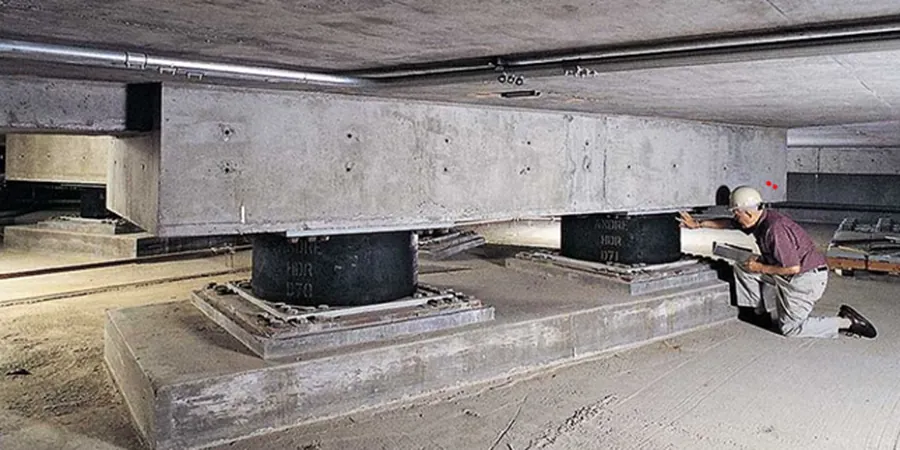
Garden Grove sits on deep alluvial deposits from the Santa Ana River, with groundwater typically found between 5 and 15 feet below grade. This geology amplifies seismic waves during a major earthquake, making foundation design a critical step before construction. Our team evaluates site-specific soil profiles using the IBC and ASCE 7 framework to determine the correct Seismic Design Category. We combine shear-wave velocity measurements with a [MASW survey](/masw-vs30/) to classify the site class, and we run liquefaction analysis when loose sands are present below the water table. The goal is a foundation system that matches the actual ground motion demands of the property.
Alluvial soils in Garden Grove amplify long-period ground motions. A proper site class determination is the first line of defense against seismic damage.
Methodology and scope
The coastal climate keeps Garden Grove soils moist year-round, which can reduce shear strength in silty and clayey layers during cyclic loading. We see this effect most clearly in the central part of the city, where older channels of the Santa Ana deposited soft sediments. Our approach starts with a thorough subsurface investigation using hollow-stem auger borings and Standard Penetration Tests. We classify each stratum by USCS and measure index properties to predict how the soil will behave under dynamic stress. For deeper profiles or projects near the 22 Freeway corridor, we add CPT soundings to capture continuous stratigraphy. The data feeds directly into a site-specific response analysis that accounts for the local basin effects unique to this part of Orange County.
Technical reference image — Garden Grove
Local considerations
Liquefaction is the primary seismic risk in Garden Grove. The combination of loose sandy soils and shallow groundwater creates conditions where pore pressure can spike during shaking, causing bearing failure. We map this hazard using the NCEER SPT-based method and site-specific cyclic resistance ratios. Another concern is lateral spreading near buried utility trenches and channel banks. Our reports include a detailed deformation estimate so the structural engineer can design foundations that tolerate the predicted displacement without compromising the superstructure.
We generate acceleration spectra using the equivalent-linear method with modulus reduction curves specific to alluvial soils. This replaces the generic code spectrum with a curve that matches the actual soil column.
02
Liquefaction Hazard Assessment
We evaluate each boring for liquefaction triggering using SPT blow counts, fines content, and cyclic stress ratios. The output includes settlement estimates and a lateral spread displacement map.
03
Foundation Type Recommendation
Based on the seismic parameters and bearing capacity, we recommend either conventional spread footings with grade beams or a mat foundation. For soft soils, we evaluate deep foundations like driven piles.
Applicable standards
ASCE 7-22 (Minimum Design Loads and Associated Criteria for Buildings), IBC 2021 (International Building Code, Chapter 18), ASTM D1586-18 (Standard Test Method for SPT), NCEER Workshop 2001 (Youd-Idriss liquefaction evaluation)
Frequently asked questions
What is the difference between Site Class D and E for Garden Grove soils?
Site Class D refers to stiff soils with shear-wave velocity between 180 and 360 m/s. Site Class E applies to soft soils below 180 m/s. Most of Garden Grove falls in Class D, but areas near the Santa Ana River channel can reach Class E. The site class directly affects the design spectral acceleration values in ASCE 7.
How much does a seismic foundation design study cost in Garden Grove?
The typical range is between US$1.340 and US$4.180 for a residential or small commercial project. The final cost depends on the number of borings, the depth of investigation, and whether advanced testing like CPT or MASW is required. Contact us for a scope-specific quote.
Can I build a house on a slab-on-grade in a liquefaction zone?
It depends on the liquefaction potential and the expected settlement. For low LPI values with less than 1 inch of post-seismic settlement, a stiffened slab with reinforcing may work. For moderate to high hazard, a post-tensioned mat or deep foundation is the safer option. We always check the local building official's requirements first.
What happens if the groundwater is only 5 feet deep during our investigation?
The reference range for this service in Garden Grove is US$1.340 - US$4.180. The final price depends on the project scope and volume.
How long does it take to complete a seismic study for a Garden Grove property?
A standard residential study with two borings, lab testing, and a report typically takes 10 to 15 business days. If we need additional field work like CPT or MASW, add 5 to 7 days. The permitting timeline depends on the city's plan check queue, but the geotechnical report itself is usually ready within three weeks.