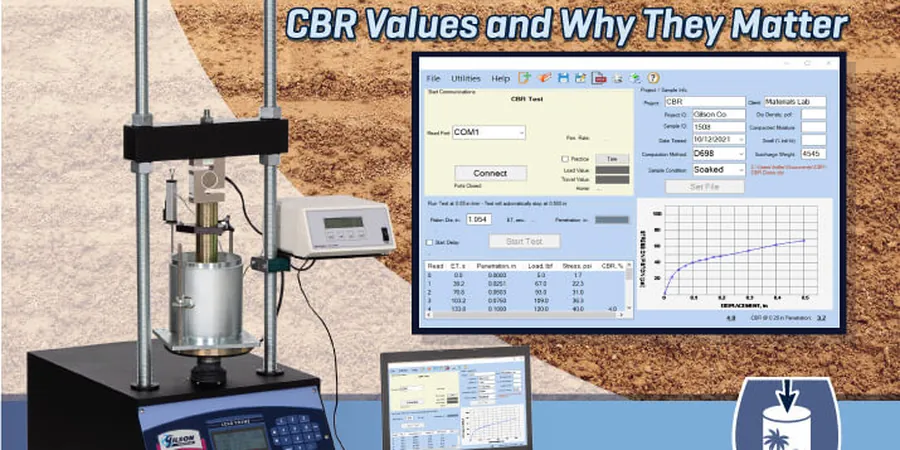
The CBR test rig sits on the back of a flatbed truck, its hydraulic ram ready to push a standard plunger into compacted soil samples. In Garden Grove, we calibrate this equipment specifically for the alluvial and marine deposits that underlie most of the city. The soils here vary from silty sands to fat clays, and each subgrade layer behaves differently under load. Our CBR study for road design measures the California Bearing Ratio directly on remolded specimens at Proctor density. The procedure follows ASTM D1883-16 with a 0.05-inch/min penetration rate. We also run companion tests like the ensayo Proctor to establish the optimum moisture content before the CBR mold is prepared. That sequence matters because a wetter or drier sample changes the bearing capacity substantially. For Garden Grove streets and parking lots, this data determines the subgrade modulus used in pavement thickness calculations.
In Garden Grove, soaked CBR values consistently fall 40-60% below unsoaked values, making saturation testing non-negotiable for pavement design.
Methodology and scope
A recent street reconstruction project on Brookhurst Street needed subgrade values for a flexible pavement design. The contractor had assumed a CBR of 5 based on regional tables, but our tests showed actual values between 3 and 7 across the alignment. That range matters for design. We combine the CBR study for road design with clasificación de suelos to classify each sample per ASTM D2487. The site had layers of ML (silt) and CL (lean clay) that behave differently under repeated traffic loads. Here is how we approach these projects:
Sample extraction at 2-ft intervals using split-spoon samplers
Moisture conditioning to three different water contents
Compaction per ASTM D698 (Standard Proctor) for each condition
Soaking for 96 hours to simulate worst-case saturation
The soaked CBR values are the ones we report for design. In Garden Grove, where groundwater sits close to the surface in some neighborhoods, the soaked condition is the realistic scenario.
Technical reference image — Garden Grove
Local considerations
Some engineering firms in Garden Grove skip the CBR study for road design and rely on published correlations from nearby cities. That is a mistake. The subgrade in the Garden Grove floodplain has a different compaction behavior than soils in Fullerton or Anaheim due to the higher clay content and variable sand lenses. Using a blanket CBR value of 6 across all zones leads to either overdesigned sections or premature pavement failure. We have seen parking lots crack within three years because the design assumed CBR 8 when the actual value was 4. The cost difference between a proper CBR test and a guess is insignificant compared to the repair bill.
Standard 96-hour soaked CBR on remolded samples. Includes moisture conditioning, Proctor compaction, penetration test, and expansion measurement. Delivered as a report with load-penetration curves.
02
Unsoaked CBR Testing
Rapid CBR at optimum moisture content without soaking. Suitable for preliminary design or low-traffic pavements. Same ASTM D1883 procedure with a 4-day turnaround.
03
Field CBR with DCP
In-situ CBR estimation using the Dynamic Cone Penetrometer. Useful for verifying subgrade uniformity along the alignment. Correlated to laboratory CBR per ASTM D6951.
What is the typical CBR range for soils in Garden Grove?
The natural subgrade in Garden Grove varies from CBR 2 in fat clay zones to CBR 8 in sandy areas. Most sites fall between CBR 3 and 6 after compaction. We recommend a site-specific test rather than relying on county-wide averages.
How long does a CBR study for road design take?
A standard laboratory CBR test takes 5-7 business days. The 96-hour soaking period is the fixed step. Field DCP testing can be completed in one day if the alignment is accessible.
Do you need undisturbed samples for CBR testing?
No. CBR is performed on remolded samples compacted to a target density and moisture content. We collect bulk disturbed samples from test pits or split-spoon sampling. The compaction step simulates field roller conditions.
What is the difference between soaked and unsoaked CBR?
Soaked CBR measures the subgrade strength after 96 hours of water immersion, simulating worst-case saturation from rain or rising groundwater. Unsoaked CBR tests at the compaction moisture content. In Garden Grove, soaked values are typically 40-60% lower.
How much does a CBR study for road design cost in Garden Grove?
Pricing ranges from US$170 to US$320 per sample depending on whether you need soaked or unsoaked testing, the number of samples, and whether field DCP is included. Contact us for a quote tailored to your project scope.