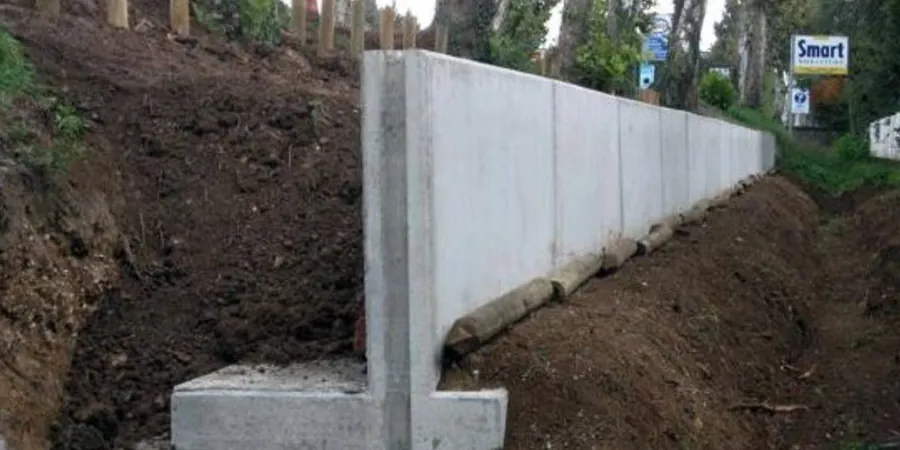
Retaining wall design in Garden Grove follows IBC 2021 and ASCE 7-16 seismic provisions, given the city's proximity to active faults like the Newport-Inglewood and Whittier fault zones. Our geotechnical team integrates site-specific soil parameters from in-situ testing and laboratory classification to define lateral earth pressures and groundwater conditions. For projects on alluvial deposits typical of the Santa Ana River basin, we combine these results with a study of soil classification to determine friction angles and cohesion values accurately. This approach ensures walls resist both static and seismic loads without overdesign.
Saturated backfill in Garden Grove demands careful drainage design — without it, hydrostatic pressure can double the lateral load on any retaining wall.
Methodology and scope
Garden Grove sits at roughly 27 meters above sea level on deep alluvial and marine terrace deposits, with the water table often encountered between 3 and 6 meters deep in the northern tracts. Retaining walls here must handle saturated backfill conditions and potential hydrostatic pressure buildup during winter storms. Our lab runs triaxial and direct shear tests per ASTM D7181 and D3080 to derive drained and undrained strength parameters specific to the site's clayey sands and silty clays. For walls exceeding 3 meters in height, we recommend performing a MASW survey to profile shear-wave velocity and refine the seismic coefficient used in the pseudo-static analysis. This data feeds directly into the design of cantilever, gravity, or mechanically stabilized earth walls.
Technical reference image — Garden Grove
Local considerations
In Garden Grove, we frequently observe that retaining wall failures stem from inadequate drainage rather than insufficient structural capacity. The high water table combined with clay lenses can trap water behind the wall, generating undrained loading that exceeds the design assumptions. Another common issue is ignoring the post-construction settlement of the retained soil: if the backfill compacts poorly, the wall tilts and cracks within two to three rainy seasons. Our team always specifies a geocomposite drain and outlet pipes with filter fabric, and we verify compaction density using the sand cone method per ASTM D1556 during placement.
SPT boreholes, test pits, and laboratory classification to obtain friction angle, cohesion, unit weight, and permeability for each soil horizon. We deliver a geotechnical report with recommended earth pressure coefficients.
02
Seismic Design Support
Site-specific response spectra and liquefaction assessment (NCEER method) for walls in seismic zones. We calculate the pseudo-static coefficient and check sliding, overturning, and bearing capacity under MCE conditions.
03
Drainage & Backfill Specification
Design of granular drainage blankets, geocomposite drains, and filter layers. We specify compaction criteria (95% of modified Proctor) and verify field density with sand cone or nuclear gauge tests.
What soil parameters are most critical for retaining wall design in Garden Grove?
The friction angle of the backfill, the cohesion of the foundation soil, and the depth of the water table are the three key inputs. We determine these through direct shear, triaxial testing, and monitoring wells placed during the site investigation.
How much does a retaining wall geotechnical study cost in Garden Grove?
The typical range for a complete retaining wall geotechnical study in Garden Grove is between US$1.020 and US$3.720, depending on wall height, number of soil borings, and laboratory tests required. The final cost is confirmed after a brief site review.
Do I need a permit for a retaining wall in Garden Grove?
Yes, Garden Grove requires a building permit for any retaining wall over 1.2 meters in height. The permit application must include a geotechnical report signed by a California licensed engineer, which we prepare as part of our study.
What type of retaining wall works best for the clay soils in Garden Grove?
For the clayey sands and silty clays prevalent in the city, we typically recommend cantilever reinforced concrete walls or MSE walls with a well-drained granular backfill. Both systems accommodate moderate settlements and can be designed to resist the seismic lateral pressures required by ASCE 7.